Recovered Document · Service Bulletin
SB-003
ARC-09 Calibration Protocol Update
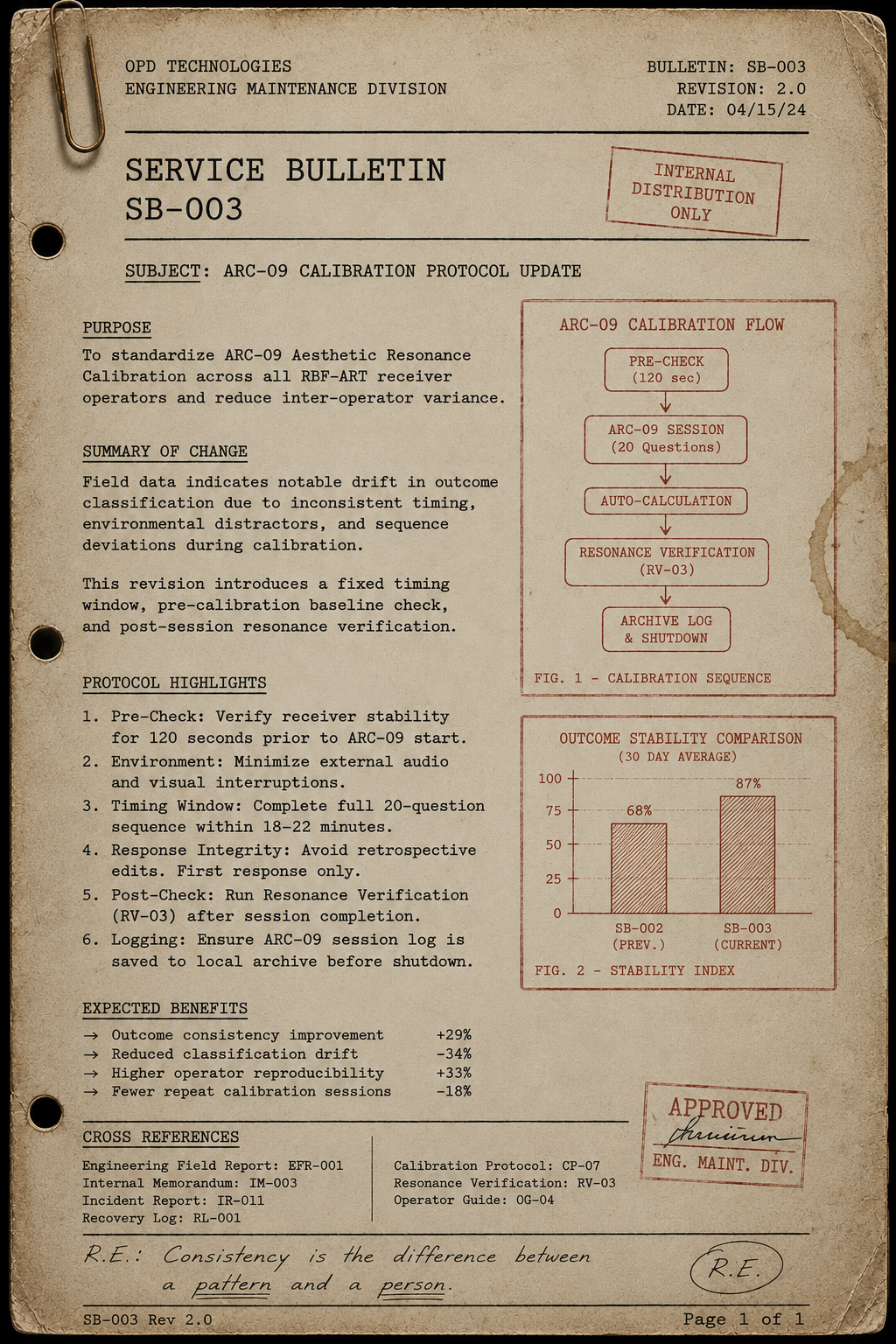
Service Bulletin SB-003 was issued after Engineering Maintenance discovered that ARC-09 calibration results were drifting for reasons that had little to do with the receiver itself.
The problem first appeared as inconsistency between operators.
Two technicians could run the same participant through the same RBF-ART system, under apparently identical conditions, and produce noticeably different resonance classifications. Early reviews focused on hardware tolerance, sensor aging, and environmental interference.
None of those explanations held.
The receiver was behaving consistently.
The procedure was not.
ARC-09 had originally been written with considerable operator discretion. Timing windows were approximate. Environmental controls were recommended rather than required. Participants could pause, revisit earlier answers, or restart sections when uncertain.
That flexibility had seemed harmless.
It was not.
Field data showed that small differences in pacing, interruption, and answer revision could accumulate into measurable outcome drift. The problem became especially pronounced when an operator attempted to “help” a participant toward a more accurate response.
Calibration referred to this as operator-shaped variance.
A participant might hesitate on a question.
One operator would wait.
Another would clarify.
A third would repeat the prompt with different emphasis.
Each believed they were preserving the integrity of the test.
In practice, they were introducing new conditions.
SB-003 therefore standardized ARC-09 around a fixed sequence.
The revised protocol begins with a 120-second receiver stability check. During that interval, no interpretive input is permitted. The system is allowed to settle, baseline noise is recorded, and the operator verifies that no residual activity from prior sessions remains above tolerance.
Only then does the twenty-question ARC-09 sequence begin.
The bulletin specifies an 18- to 22-minute completion window, limits external audio and visual interruption, and requires first-response preservation.
That last requirement caused the most internal debate.
Under the revised procedure, participants may hesitate.
They may dislike an answer.
They may immediately think of a better one.
The original response is still the response.
Calibration argued that retrospective editing did not necessarily improve accuracy. In many cases it replaced spontaneous resonance with self-correction.
Systems Engineering initially objected that this made the protocol less precise.
Calibration replied that the protocol was not measuring editorial skill.
The dispute is reflected in several later internal notes.
SB-003 does not resolve the philosophical argument directly. It simply makes the process reproducible enough that the argument can be measured.
After the twenty-question sequence, the system performs an automatic calculation and enters Resonance Verification RV-03.
RV-03 compares the completed session against baseline receiver behavior and checks for outcome instability that may indicate environmental contamination, operator interference, or sequence deviation.
Only after verification is complete is the session archived and the receiver shut down.
The revised procedure produced immediate improvements.
Thirty-day comparisons showed outcome stability increasing from approximately 68 percent under the prior procedure to 87 percent after SB-003 implementation.
Engineering Maintenance also recorded a 29 percent improvement in outcome consistency, a 34 percent reduction in classification drift, and a substantial decrease in repeat calibration sessions.
Those numbers were enough to justify the revision.
The reason they improved remained more interesting.
Nothing about the receiver had become more sensitive.
Nothing about ARC-09 had become more intelligent.
The operators had simply been given fewer opportunities to influence what they were attempting to observe.
The recovered bulletin contains a handwritten annotation at the bottom of the page:
“Consistency is the difference between a pattern and a person.”
The note is attributed only to R.E.
Its meaning has been interpreted several ways.
Engineering staff generally read it as an argument for standardization: a reproducible pattern can be tested, while a result dependent on one particular operator cannot.
Calibration took the sentence differently.
To them, the danger was not that people were inconsistent.
People were supposed to be inconsistent.
The danger was mistaking the operator’s habits for the participant’s signal.
That distinction eventually became central to later ARC revisions.
SB-003 also established an important operating principle that appears repeatedly in subsequent documentation:
A calibration procedure should constrain the observer before it constrains the subject.
This principle influenced later RBF-ART testing far beyond ARC-09. Field reports began documenting operator conditions alongside participant conditions. Session timing was logged more carefully. Environmental interruption thresholds were formalized. Even seemingly minor behaviors, such as repeating a question or changing vocal emphasis, became reportable variables.
The effect was not to remove humanity from the process.
It was to stop pretending the human running the process was invisible.
SB-003 was approved by Engineering Maintenance and distributed internally as Revision 2.0.
The bulletin remains cross-referenced with EFR-001, IM-003, IR-011, RL-001, Calibration Protocol CP-07, Resonance Verification RV-03, and Operator Guide OG-04.
No major hardware modification accompanied the update.
The improvement came almost entirely from procedure.
For a company that spent so much time designing better receivers, SB-003 was an uncomfortable reminder:
Sometimes the easiest way to improve the signal is to standardize the person holding the instrument.
Document Status
This document has not been transferred to the Capacity Expansion Filing Room.
Recovery Complete — document transferred to CEFR-SB-6.
Transfer to Filing Room Open in Filing Room