Recovered Document · Recovery Log
RL-002
Maintenance Alcove Recovery
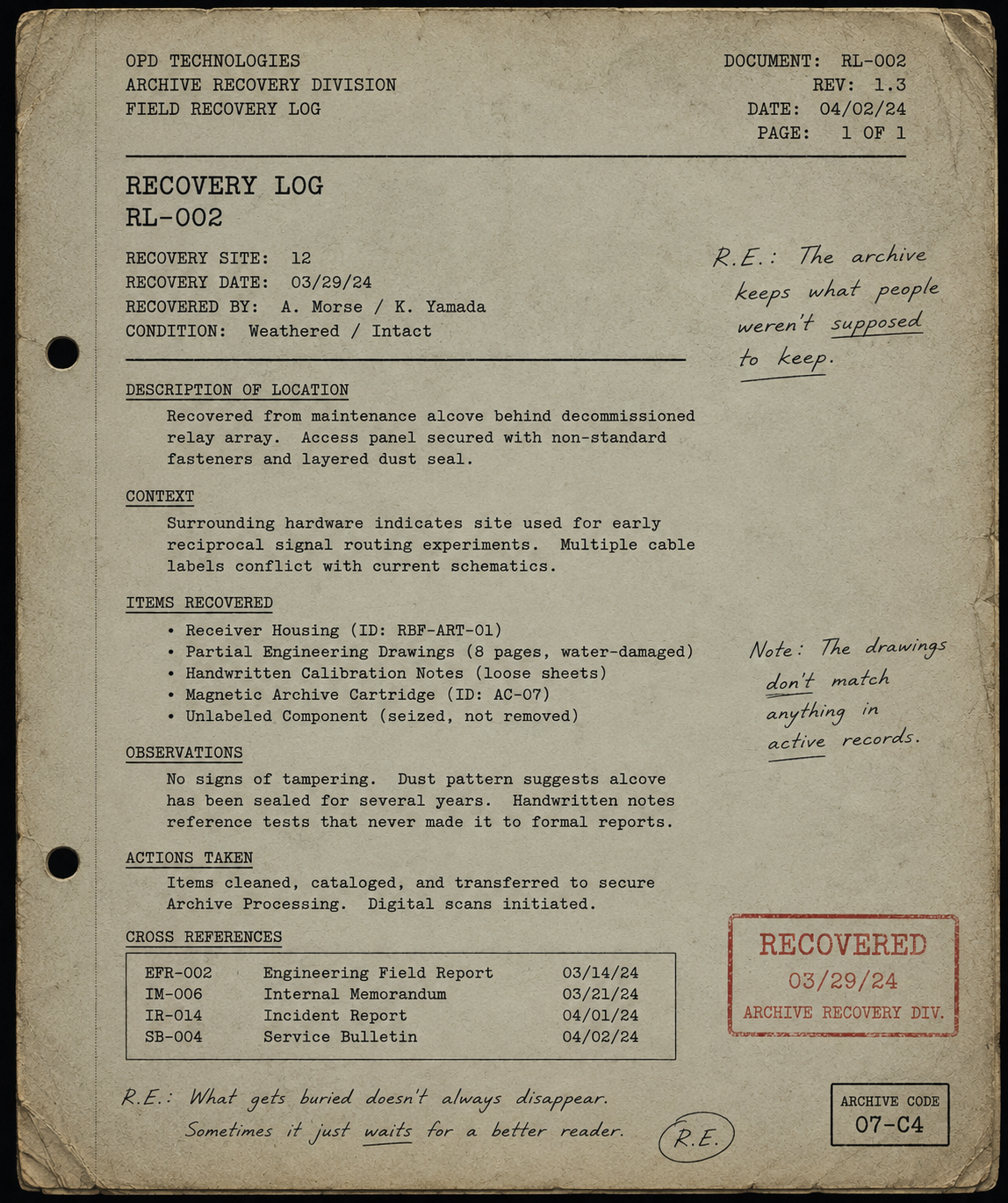
Recovery Log RL-002 documents the discovery of a sealed maintenance alcove at Recovery Site 12 containing materials that did not match any active OPD Technologies inventory record.
The compartment was found behind a decommissioned relay array during a routine structural inspection. Nothing about the enclosure suggested urgency. There were no emergency markings, no security labels, and no indication that the space had been accessed recently.
The only unusual feature was the dust.
A continuous layer covered the surrounding hardware, conduit, and access frame. The fasteners holding the panel in place were non-standard but undisturbed. Recovery personnel estimated that the alcove had remained sealed for several years.
Whatever was inside had apparently been placed there deliberately.
And then left alone.
The contents included a receiver housing identified as RBF-ART-01, eight pages of partial engineering drawings, several loose handwritten calibration sheets, a magnetic archive cartridge labeled AC-07, and one unidentified component that Recovery staff were specifically instructed not to remove.
The drawings presented the first problem.
They appeared authentic.
Paper stock, drafting conventions, component notation, and revision formatting all corresponded to OPD Technologies engineering documentation from the same period.
The designs themselves did not.
No matching assemblies could be located in active schematics.
Several cable-routing paths contradicted the approved RBF-ART architecture. Connector positions appeared where no connectors were documented. One drawing showed a return path that Systems Engineering later described as “functionally unnecessary.”
Another appeared to route a signal back toward its presumed source.
No explanation accompanied it.
The handwritten notes were stranger.
Most lacked dates.
Some appeared to reference tests that were never entered into formal field reports. Others contained fragments of observations without enough context to reconstruct the experiment.
Several phrases recurred across pages written in different hands:
“Do not correct too early.”
“Receiver still active after source withdrawal.”
“Difference persists when measurement stops.”
One sheet contained only a timestamp and the sentence:
“It changed after we stopped looking for the change.”
Archive Recovery initially treated these as informal engineering notes.
Calibration requested that they be preserved separately.
That decision became more important after the archive cartridge was examined.
AC-07 contained a partial index of test identifiers, many of which corresponded to known documents: EFR-002, IM-006, IR-014, and SB-004.
Several others did not exist anywhere in the current archive.
Not missing.
Not redacted.
Simply absent.
This raised an uncomfortable possibility.
The alcove might not have been storage for abandoned equipment.
It may have been storage for abandoned conclusions.
OPD Technologies documentation from this period shows repeated disagreement between Systems Engineering and Calibration over how much significance should be assigned to observer behavior during RBF-ART testing.
Engineering generally preferred measurable faults.
Calibration increasingly argued that the act of observing, anticipating, verifying, or attempting to preserve a signal could alter the conditions under which the signal was being interpreted.
RL-002 appears to sit directly inside that dispute.
The recovered drawings contain several apparent attempts to isolate the receiver from operator-driven feedback. The handwritten material repeatedly distinguishes between signal persistence and perceived continuity.
Yet none of those experiments appear in the formal development record.
Someone performed the work.
Someone documented it.
Someone chose not to file it with everything else.
The recovered copy of RL-002 contains a handwritten annotation in the upper margin:
“The archive keeps what people weren’t supposed to keep.”
There is no signature beyond the familiar initials R.E.
A second note beside the engineering drawings reads:
“The drawings don’t match anything in active records.”
This observation was later confirmed.
Attempts to reconcile the diagrams with documented RBF-ART revisions produced several partial matches but no complete assembly.
One theory proposed that the drawings represent an intermediate prototype.
Another suggests they describe modifications that were tested but never approved.
Archive Processing has never assigned an official interpretation.
The unidentified component remains the most carefully avoided part of the recovery log.
It is listed only as:
Unlabeled Component — seized, not removed.
No dimensions are provided.
No photograph appears in the archive copy.
The recovery team did not explain why an object could be seized without being removed.
Later requests for clarification were returned with the same instruction:
Leave in original position pending Systems review.
No surviving Systems review has been located.
The final handwritten note at the bottom of RL-002 is less technical than the rest:
“What gets buried doesn’t always disappear. Sometimes it just waits for a better reader.”
That sentence eventually became unofficial Archive Recovery shorthand for materials that acquire significance only after later documents are discovered.
RL-002 is now considered one of the first major examples.
At the time of recovery, the collection looked incomplete.
After EFR-002, IM-006, and IR-014 were reexamined together, the alcove began to resemble something else:
a preserved branch of the RBF-ART program that had been removed from the official story without being fully destroyed.
The materials remain cataloged under Archive Code 07-C4.
The drawings are still unresolved.
AC-07 remains only partially indexed.
And according to the most recent archive notation, the unidentified component is still exactly where Recovery found it.
Document Status
This document has not been transferred to the Capacity Expansion Filing Room.
Recovery Complete — document transferred to CEFR-SB-6.
Transfer to Filing Room Open in Filing Room