Recovered Document · Incident Report
IR-014
Interpretive Escalation During Silent Operation
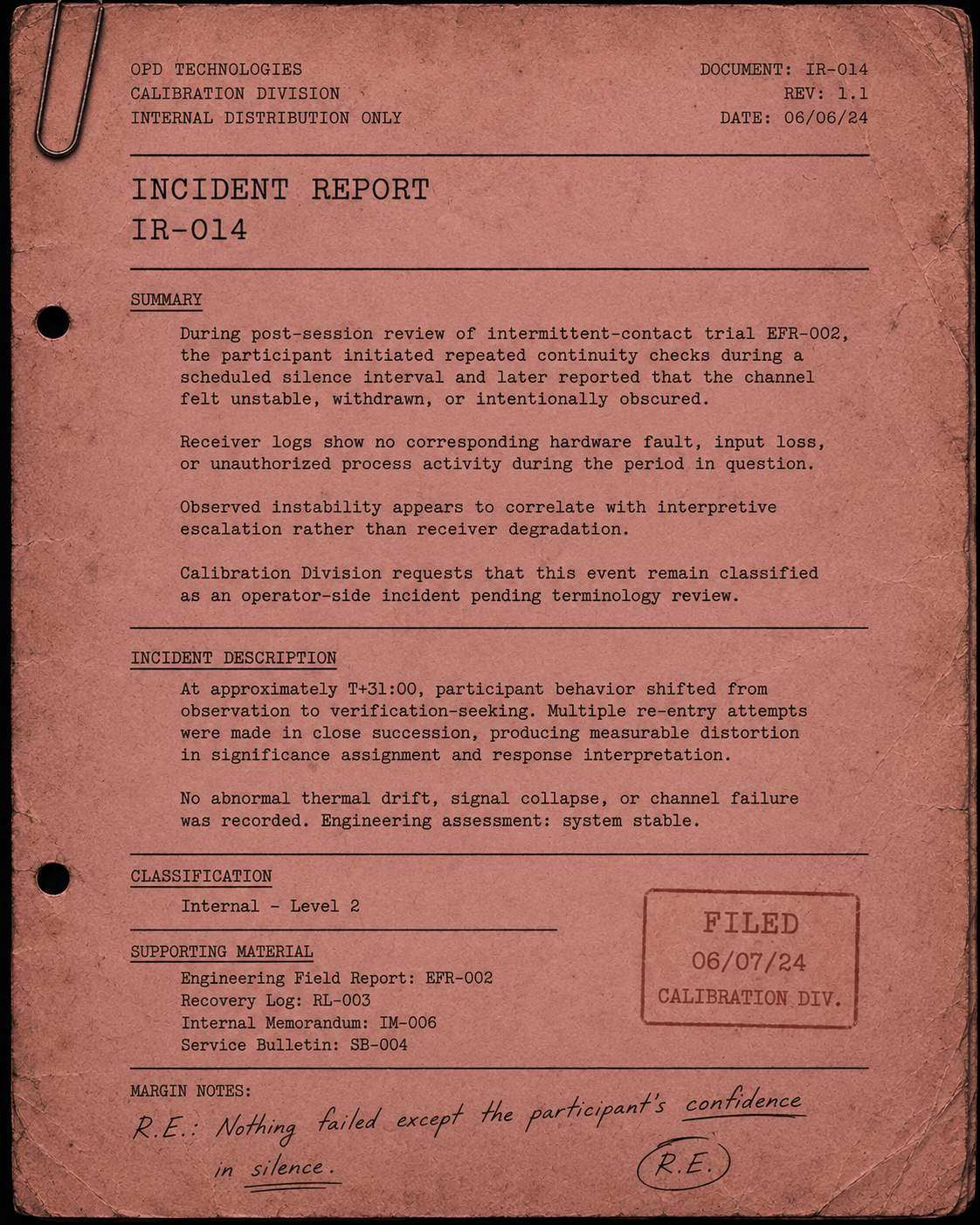
Incident Report IR-014 was opened after the review team discovered that the most serious instability recorded during intermittent-contact testing had not originated inside the receiver at all.
The report concerns the same test sequence documented in Engineering Field Report EFR-002 and later analyzed in Internal Memorandum IM-006. By the time IR-014 was filed, Systems Engineering had already concluded that the hardware remained within specification throughout the event.
Calibration was less interested in the hardware.
Their concern was what happened to the participant once the channel became quiet.
During the scheduled silence window, the participant initially followed procedure. No new signal was introduced, no corrective input was requested, and the receiver continued to report stable baseline behavior.
Then the participant began checking.
The first continuity check was minor.
A second followed shortly afterward.
Then another.
Each attempt was intended to answer a simple question: Is the connection still there?
But every attempt also changed the conditions being measured.
By approximately T+31:00, the participant was no longer observing an inactive channel. They were repeatedly probing it for reassurance.
Calibration classified this shift as verification-seeking behavior.
The distinction mattered because the participant later described the channel itself as unstable, withdrawn, or intentionally obscured.
Receiver logs showed none of those conditions.
No thermal anomaly occurred.
No signal collapse was recorded.
No unauthorized process activated.
No hardware fault appeared.
The only variable undergoing rapid change was the participant's interpretation.
This created an unusual reporting problem.
Traditional incident documentation assumes that an incident has happened to the equipment, the environment, or the operating procedure. IR-014 was different.
Engineering's assessment was blunt:
System stable.
Calibration nevertheless insisted that an incident had occurred.
Their argument was that a stable machine does not make a destabilized measurement harmless.
If an operator becomes increasingly certain that a functioning system has failed, the resulting behavior can become operationally significant even when the original equipment remains healthy.
The report therefore became one of the earliest OPD Technologies documents to describe an operator-side incident.
An operator-side incident occurs when observation is displaced by attempts to reduce uncertainty.
The participant begins with incomplete information.
That incompleteness becomes uncomfortable.
A test is performed to restore certainty.
The result of the test is then interpreted through the uncertainty that caused the test in the first place.
Another test follows.
Eventually the operator is no longer gathering independent evidence. Each new action is reacting to the previous action.
The loop begins producing its own signal.
Later Calibration documents referred to this as Interpretive Escalation.
IR-014 is valuable because it captures the transition almost perfectly.
Before T+31:00, the participant's reports remained tentative.
After repeated verification attempts began, their conclusions became stronger even though the available evidence did not.
Uncertainty decreased.
Accuracy did not improve with it.
That discrepancy became a major concern for the Calibration Division.
Confidence had traditionally been treated as a useful secondary indicator during RBF-ART operation. Operators familiar with the equipment could often recognize stable alignment before every numerical measurement had settled.
IR-014 demonstrated the danger of treating confidence as evidence on its own.
Confidence could increase during correct interpretation.
It could also increase during a self-reinforcing mistake.
The recovered document contains a handwritten annotation attributed only to R.E.:
“Nothing failed except the participant's confidence in silence.”
The wording is intentionally ambiguous.
The participant did not lose confidence.
They became increasingly confident that silence meant something was wrong.
What failed was their ability to allow silence to remain unresolved.
That distinction became important enough that later operator training separated three conditions that had previously been treated as one:
Signal Loss — measurable disappearance of incoming information.
Interpretive Overflow — inferred information exceeds available information.
Verification Loop — repeated attempts to resolve uncertainty begin altering the observation environment itself.
IR-014 is believed to be the first surviving document where all three concepts can be reconstructed from a single event.
No disciplinary action was taken against the participant.
Calibration specifically opposed describing the behavior as misuse.
The incident was considered a predictable interaction between human uncertainty and a system designed to measure subtle reciprocal signals.
The corrective action therefore focused on procedure rather than blame.
Later operating guidance instructed users to establish a confirmed baseline before silent periods, avoid unnecessary continuity checks, and record uncertainty as uncertainty rather than immediately converting it into diagnosis.
The change sounds small.
Within the archive, it represents a substantial philosophical shift.
OPD Technologies had spent years improving receiver sensitivity.
IR-014 suggested that sensitivity was not always the limiting factor.
Sometimes the instrument was already sensitive enough.
The operator simply needed to stop asking it the same question.
IR-014 remains filed as Internal — Level 2 and is cross-referenced with EFR-002, RL-003, IM-006, and SB-004.
No receiver repair was authorized.
No component was replaced.
The incident was closed with the system still operating exactly as designed.
Document Status
This document has not been transferred to the Capacity Expansion Filing Room.
Recovery Complete — document transferred to CEFR-SB-6.
Transfer to Filing Room Open in Filing Room