Recovered Document · Internal Memorandum
IM-006
Expectation Load During Silent Windows
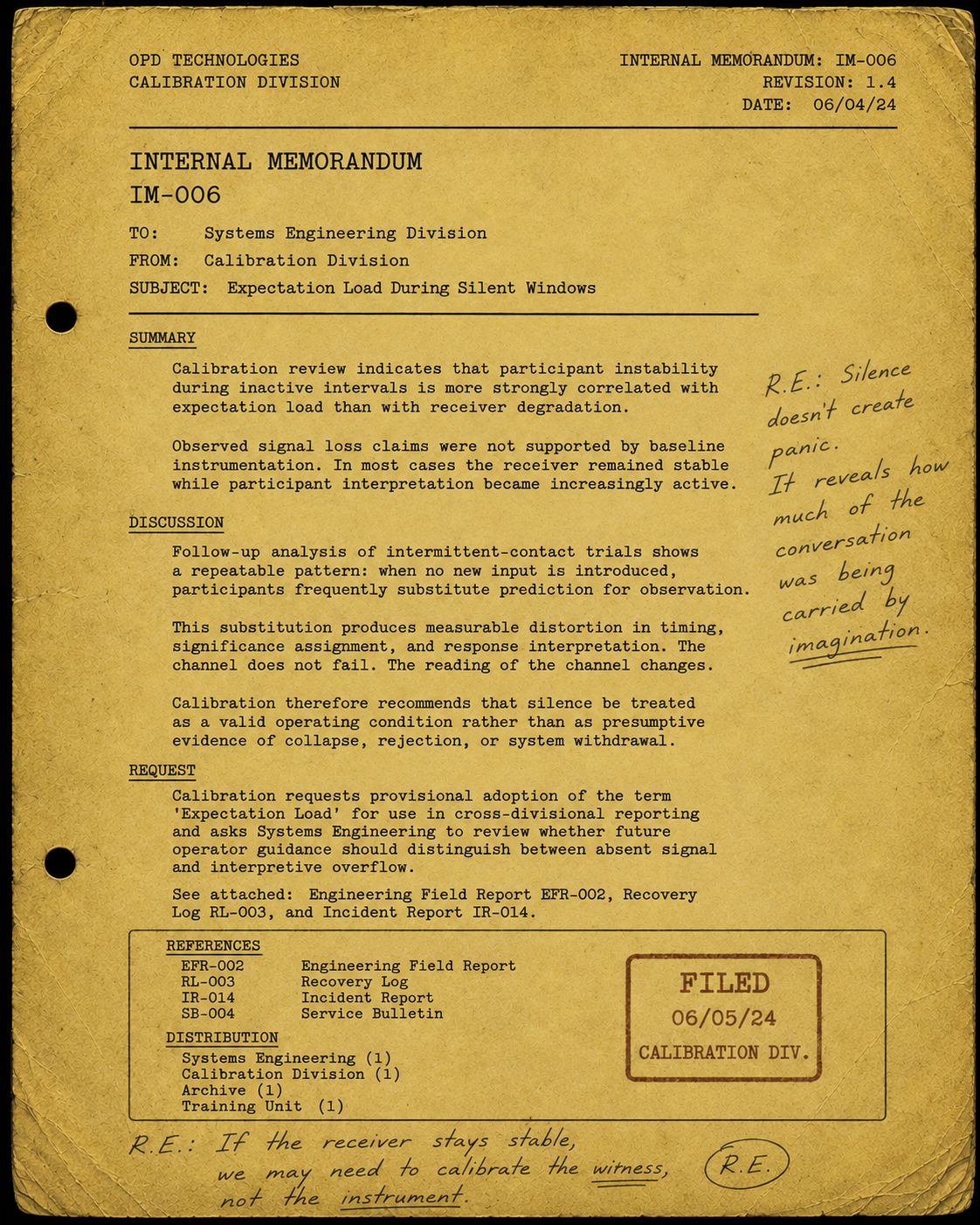
Internal Memorandum IM-006 marks the point at which OPD Technologies formally stopped treating silence as a failure condition.
The memo was issued by the Calibration Division after review of several intermittent-contact trials, including Engineering Field Report EFR-002. Those earlier tests had produced a recurring contradiction: participants frequently reported weakening connection, deteriorating alignment, or probable receiver failure during periods when the instrumentation itself remained within tolerance.
Calibration’s concern was not that the equipment was missing something.
It was that the operator might be adding something.
The memorandum introduced a provisional term for this effect:
Expectation Load.
Expectation Load describes the interpretive pressure that accumulates when an operator continues searching for meaning after the available signal has stopped changing.
Under active conditions, the distinction between observation and interpretation is easy to maintain. A signal arrives. The receiver changes. Measurements can be compared against new input.
Silent windows are less cooperative.
When no new information appears, the observer still possesses the previous information, memory of the previous state, anticipation of the next state, and some expectation about what continuity should look like.
Those materials do not remain inert.
Calibration noted that, after sufficient delay, many operators began using expectation as substitute data.
Timing acquired emotional significance.
Latency became directional.
Neutral absence was reclassified as deterioration.
Previous observations were replayed and examined for overlooked meaning.
Minor fluctuations that would ordinarily fall beneath reporting thresholds suddenly appeared important.
Nothing had necessarily happened to the channel.
A great deal had happened to the interpretation of it.
This was the central concern of IM-006.
The memo’s authors argued that existing operating procedures assumed too strongly that observer perception remained passive. RBF-ART documentation had traditionally separated the system into transmitter, channel, and receiver. The participant observing the output was treated largely as an external reader.
Calibration no longer believed that model was sufficient.
The observer was part of the measurement environment.
And under silent conditions, the observer could become the loudest component in it.
A handwritten note in the right margin reduces several pages of internal discussion to one line of remarkable efficiency:
“Silence doesn’t create panic. It reveals how much of the conversation was being carried by imagination.”
The wording was never adopted into formal documentation.
The underlying concept was.
Following IM-006, Calibration began distinguishing between Absent Signal and Interpretive Overflow.
Absent Signal refers to a measurable reduction or disappearance of incoming information.
Interpretive Overflow occurs when the amount of inferred information exceeds the amount actually present in the channel.
The distinction sounds obvious.
Field testing suggested otherwise.
Operators experiencing interpretive overflow often displayed greater confidence in their conclusions than operators working from active signal. The absence of new evidence did not necessarily increase uncertainty. In some cases it produced the opposite effect.
Without incoming data to contradict the developing interpretation, the interpretation became increasingly self-consistent.
This presented a serious calibration problem.
A receiver can be tested.
A cable can be replaced.
Noise can be isolated.
But a conclusion generated entirely from expectation may still appear perfectly reasonable to the person generating it.
IM-006 therefore recommended that silent windows be recognized as a valid operating state rather than a transitional error state.
No intervention should be initiated solely because communication has paused.
No continuity test should be performed merely to relieve uncertainty.
Operators were advised to separate what the system had actually produced from what they expected the system to produce next.
In later training materials this became known informally as the Blank Channel Procedure:
Record the last confirmed signal.
Record the present instrument state.
Do not enter a third measurement for what the silence appears to mean.
The memorandum stops short of claiming that interpretation itself is undesirable. RBF-ART depends on interpretation; resonance without meaning would be little more than instrumentation.
The concern is sequencing.
Interpretation should follow signal.
It should not replace it.
The final handwritten annotation on the recovered copy appears beneath the distribution box:
“If the receiver stays stable, we may need to calibrate the witness, not the instrument.”
That sentence caused considerable disagreement between Calibration and Systems Engineering.
Engineering objected to describing human operators as calibratable components.
Calibration objected to pretending they were not.
Neither division formally won the argument.
Subsequent revisions quietly incorporated the distinction anyway.
IM-006 remains cross-referenced with EFR-002, Recovery Log RL-003, Incident Report IR-014, and Service Bulletin SB-004.
The terminology first proposed in this memorandum now appears throughout later OPD Technologies documentation.
The original filing stamp is dated 06/05/24.
No hardware modification was authorized.
The receiver was never determined to be defective.
Document Status
This document has not been transferred to the Capacity Expansion Filing Room.
Recovery Complete — document transferred to CEFR-SB-6.
Transfer to Filing Room Open in Filing Room