Recovered Document · Engineering Field Report
EFR-002
Delayed Reciprocity Under Intermittent Contact
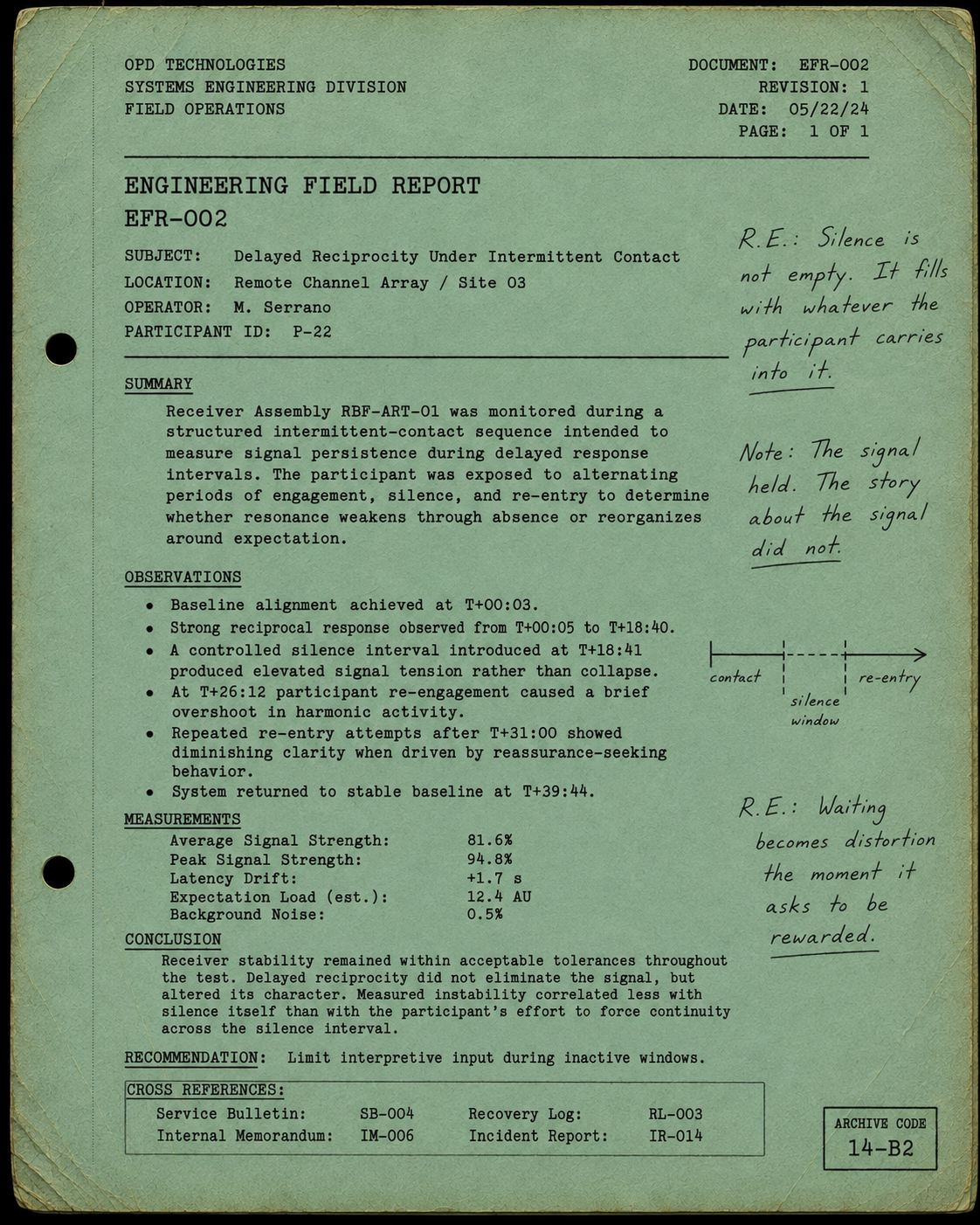
Engineering Field Report EFR-002 documents one of the more persistent problems encountered during early RBF-ART receiver testing: the tendency to interpret silence as signal loss.
The test itself was unremarkable by Field Operations standards. Receiver Assembly RBF-ART-01 was placed into a controlled remote-channel configuration and exposed to alternating periods of contact, silence, and re-entry. The objective was to determine whether an established reciprocal signal degraded when one side of the exchange became temporarily inactive.
Initial alignment occurred normally. Signal strength rose quickly, reciprocal response remained stable, and no significant interference was recorded during the first eighteen minutes of testing.
The anomaly appeared only after communication stopped.
At T+18:41, operators initiated a scheduled silence interval. No transmission was sent. No corrective input was introduced. The receiver remained active and continued to register residual harmonic structure from the preceding exchange.
Technically, the signal remained healthy.
The participant did not.
Within several minutes, expectation load began to increase despite no measurable change in the receiver itself. Small fluctuations that had previously been treated as ordinary background variation were assigned greater significance. Latency began to be interpreted as deterioration. Absence of new input was gradually treated as negative input.
This distinction became the central finding of EFR-002.
The system was not losing the signal. The participant was constructing a story about its absence.
When contact resumed at T+26:12, the receiver registered a brief harmonic overshoot. Engineers initially believed this indicated a rebound effect caused by the silence interval. Subsequent analysis suggested something more complicated.
The overshoot correlated closely with participant behavior.
Re-entry was immediately followed by attempts to verify continuity, reproduce earlier conditions, and determine whether the previous alignment remained intact. Each additional attempt introduced measurable instability. Signal clarity improved only after deliberate verification behavior ceased.
The receiver had tolerated silence considerably better than the operator using it.
A handwritten margin note later added by an unidentified reviewer summarized the issue more efficiently than the formal report:
“The signal held. The story about the signal did not.”
That observation would eventually become important to later RBF-ART revisions.
Early design assumptions treated reciprocity as a continuous exchange. Input entered the system, response returned, and alignment was maintained through repetition. EFR-002 suggested that this model was incomplete.
Reciprocity could persist through inactivity.
What changed during silence was not necessarily the relationship between transmitter and receiver, but the amount of interpretive material introduced by the observer.
This led Engineering to propose the concept of Expectation Load: a non-electrical measurement describing the amount of meaning an operator attempts to extract from a channel when insufficient new information is available.
Expectation Load is difficult to quantify directly. Its effects, however, are easy to observe.
Under low expectation conditions, silence produces little instability. The system remains available for future input without attempting to predict it.
Under elevated expectation conditions, the operator begins generating substitute data.
Previous signals are replayed.
Minor variations become evidence.
Timing becomes meaningful.
Absence becomes directional.
Eventually, the observer is no longer measuring the channel. They are measuring their own prediction of what the channel should be doing.
Field Operations classified this as interpretive feedback contamination.
The recommendation attached to EFR-002 was therefore unusually simple:
Limit interpretive input during inactive windows.
No hardware modification was required.
No firmware defect was identified.
No additional receiver sensitivity was recommended.
The proposed correction was procedural: when the channel is silent, allow it to remain silent.
Later engineering memoranda would expand this principle into a broader operating guideline. RBF-ART systems perform best when observation remains observational. Attempts to force continuity, verify meaning, or manufacture reassurance introduce noise that is often indistinguishable from genuine signal change.
The most quoted annotation on the recovered report appears near the lower-right margin:
“Waiting becomes distortion the moment it asks to be rewarded.”
Its author is unknown.
The sentence does not appear in any approved technical manual.
It remains in the archive anyway.
EFR-002 is currently cross-referenced with Service Bulletin SB-004, Internal Memorandum IM-006, Recovery Log RL-003, and Incident Report IR-014. Several later documents cite the test as the first formal evidence that RBF-ART receiver instability could originate entirely within the observer rather than the system being observed.
The original field report remains filed under Archive Code 14-B2.
No subsequent revision has changed its recommendation.
Document Status
This document has not been transferred to the Capacity Expansion Filing Room.
Recovery Complete — document transferred to CEFR-SB-6.
Transfer to Filing Room Open in Filing Room